
Are you in drinks, paper, packaging, or any other sector where the manufacturing process historically dictated the economics?
Then this will sound familiar.
Logistics was never the focus. The attention was on the factory — improving machines, increasing OEE, pushing yields higher, automating production lines. Warehousing and transport were simply there to support manufacturing and were often run at factory level… with those factories operating as small kingdoms.
Now every cent has been squeezed out of manufacturing. Logistics has become one of the last remaining differentiators. It affects service and has meanwhile become a serious cost driver.
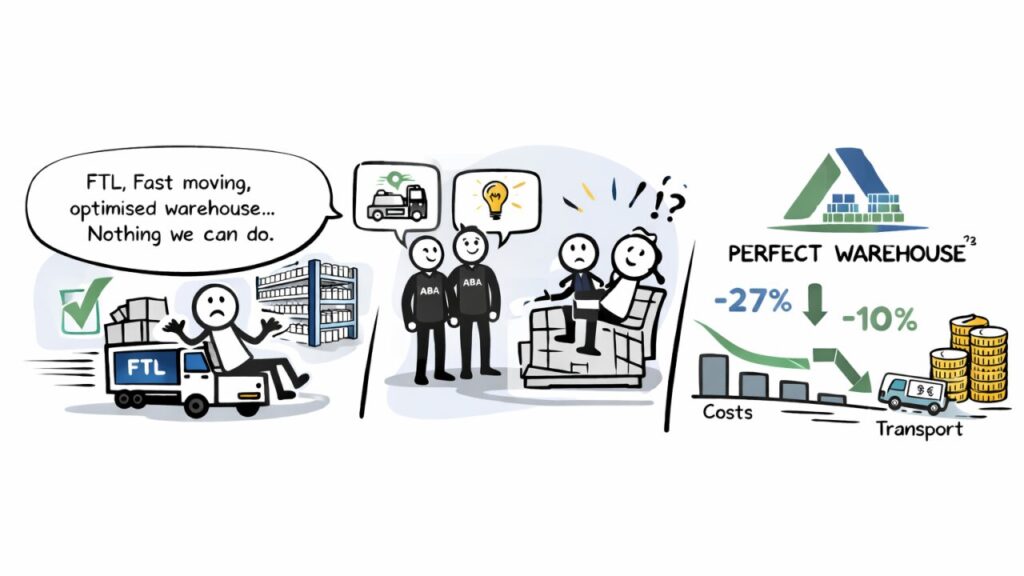
Still, many companies — and even some of the top consultancies we have worked alongside — believe there is little that can be done.
🚛 Trucks already run full. 🏬 Warehousing is outsourced.
The only suggestion seems to be to bang the same old drum: negotiate a bit harder with transport providers, consolidate trucking,…
Yet we still manage to drive very significant savings in warehousing – saving over 25% on average in costs – and transportation – over 10% savings – in these industries while improving service levels at the same time.
How We Got Here
A transformation is not a large project.
Industries such as drinks, paper and cardboard, packaging and others have historically been driven by manufacturing economics.
Companies invested heavily in improving manufacturing performance: better machines, more automation, improved scheduling systems, better yield,…
At the same time, logistics was cheap: fuel was cheap, labour was cheap, warehouse space was cheap.
So nobody built deep expertise around it. Not the companies themselves and, as it was never seen as an issue, it never really became a focus area for the consulting industry either.
And Suddenly Logistics Became Important…
Fast forward to the 2020s.
Several structural shifts happened at the same time:
• Interest rates increased significantly, pushing the cost of warehouse space up.
• The labour market changed dramatically. Especially in Europe, where the generation of “cheap Eastern European labour” that entered the workforce in the 1990s is now retiring — and where those countries have largely closed the economic gap with Western Europe (in some cases even surpassed it). Younger generations are simply not willing to work in warehousing or trucking under the same conditions anymore.
• Fuel prices increased dramatically.
• On top of that, logistics now faces additional structural costs: CO₂ charges, carbon footprint regulations, road tolls and other regulatory pressures.
Put all of this together and logistics costs have multiplied — in some cases by a factor of three or four.
This is particularly painful in industries that ship large volumes of relatively heavy, low-margin products where transport now becomes a major cost element.
To add to the challenge, in many large manufacturing companies logistics decisions have historically been left to the manufacturing sites themselves, leading to a logistics landscape that is very fragmented. Some do not even know how many warehouses they actually operate, operating many small facilities run by local logistics providers.
Simply consolidating these fragmented warehouses into a properly designed and controlled warehouse (cost) structure can already unlock significant improvements.
But this fragmentation also drives transport inefficiencies. When a manufacturing site operates several small warehouses, transport flows quickly become unnecessarily complicated. Instead of loading a truck once and sending it directly to the customer, they often run internal shuttle movements between the factory and several nearby depots, or trucks must collect goods from multiple locations before leaving for the customer.
Yes, technically you are shipping full truckloads. But that truck might have to stop at two or three different warehouses before completing its load.
Each stop creates cost.
💰 The average loading stop typically costs around €50 plus mileage. So if a truck needs to stop at two additional warehouses before leaving for the customer, it easily adds €150 to the cost of a single shipment.
Thinking Differently About Eliminating Costs
Most practitioners try to reduce logistics costs by asking the classic optimisation questions:
• Can we negotiate better transport rates? • Can we optimise certain warehouse processes? • Can we increase truck fill rates slightly?
But the real cost drivers are often somewhere else entirely.
In large-volume, fast-moving supply chains, the issue is usually variability in logistics.
Daily volume fluctuations create operational peaks. Peaks require extra labour. When volumes drop again, labour becomes underutilised. Rush orders appear. Transport capacity needs to be bought on the spot market. Trucks miss loading slots. Backorders create additional shipments…
The baseload cost has often already been optimised — but all these small disruptions generate additional costs.
Our work in these industries therefore focuses less on traditional optimisation and more on removing variability from the logistics network.
In transportation, that means identifying and eliminating the operational drivers of instability: rush orders, need for spot transport purchases, back orders,…
Working with one of the largest soft drinks bottlers in the world, this approach allowed us to generate 27% savings in warehousing and more than 10% savings in transportation — across more than 80 warehouses.
We developed a blueprint for the Perfect Warehouse and rolled it out across the network.
Some of the solutions were unconventional, but they delivered significant cost reductions without affecting service levels — in contrary.
Let’s Talk
At AB Advisors, this is exactly the type of challenge we focus on.
We worked with many industries where logistics historically were a non-issue — until it suddenly becomes one of the biggest cost and service drivers in the business.
Our work is not about negotiating cheaper trucks but using fewer trucks. It is about rethinking how the logistics system actually works, eliminating hidden cost drivers and unlocking improvements many organisations assume are no longer possible.
📞 If this situation sounds familiar in your company, set up a call to discuss our Perfect Warehouse concept and explore how you could significantly reduce your logistics costs.
Because in many cases, the logistics savings companies believe are no longer available are still very much there.








0 Comments