The business needs cash this quarter, but reducing inventory still feels like a wager on customer service. Finance can see the value on the balance sheet. It cannot yet see which products can be held in smaller quantities without creating a different problem.
A general reduction target gets the exercise started. It leaves the difficult decisions with people who have good reasons for protecting their stock.
There is also a risk once the reduction begins. Goods leave the warehouse, the inventory balance improves, and purchasing continues to replace them at the previous quantities. Cash that was expected to be available is committed to stock again.
A useful inventory programme must connect the opportunity identified in the analysis with the decisions governing what gets bought afterwards.
Understanding Why the Stock Is There
Inventory accumulates through decisions that can look reasonable in isolation. Larger purchases may protect a supplier price. Additional stock may cover an occasional customer requirement. Planning parameters may preserve a buffer whose original justification has never been revisited.
Taken together, those decisions can leave substantial capital committed to products that barely move.
A uniform percentage cut does little to distinguish between them. Reducing a critical component and reducing a rarely requested spare part may have very different consequences, even if both contribute the same amount towards a financial target.
The analysis therefore needs to establish what the stock is protecting and whether that protection is still justified.
When an Occasional Order Becomes a Permanent Stock Requirement
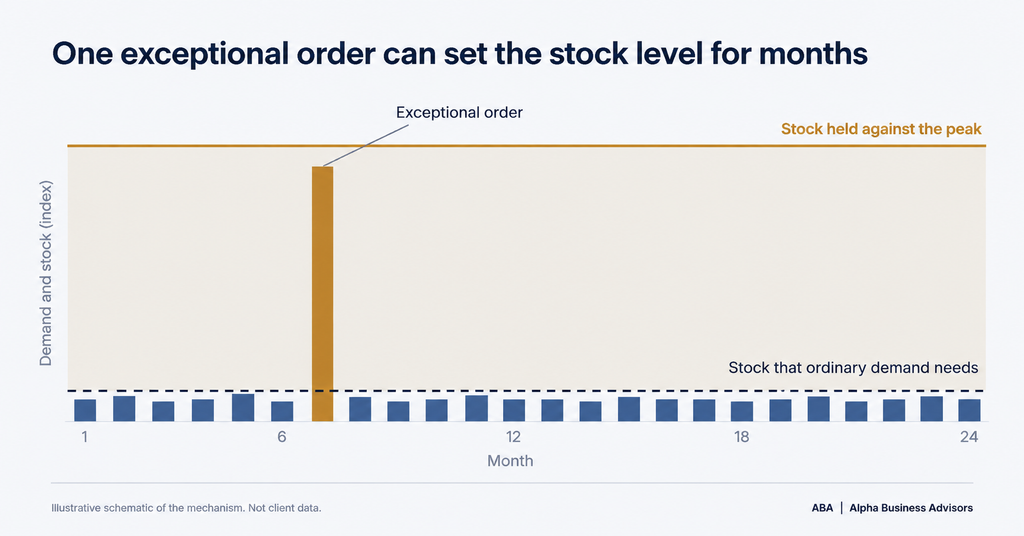
At a spare parts supplier we worked with, certain customers bought enough in one transaction to cover three to six months of their usual purchases. These orders sometimes arrived only every six to twelve months, but could exhaust the available stock and leave nothing for other customers.
The planning approach absorbed these exceptional quantities into its view of normal demand. Stock was consequently maintained for long periods against purchases that might not happen again in the same form.
Slow-moving products accounted for approximately 30% of inventory value. We examined 80% of the items in that category, using the client’s SAP data in an ABA simulation model to test alternative planning settings.
For that selected group, the model indicated a possible inventory reduction of approximately 60%, accompanied by an estimated decline of one percentage point in the proportion of sales orders fulfilled from stock.
Those were projected outcomes, giving management a specific service-versus-stock decision to evaluate. Whether the trade-off was acceptable depended on the products concerned.
The customer-order policy also needed attention. We proposed allocating available quantities so that an unusually large purchase could not automatically consume stock intended to serve other customers. Requirements above the allocation would need separate handling. A modest SAP enhancement was proposed to support this policy, avoiding the complexity of the standard SAP alternative.
The analysis had produced something management could assess: a defined reduction opportunity, its expected service effect, and a proposed change to how exceptional orders were handled.
Reaching a Decision Before All the Cash Can Be Released
Finance needs that level of specificity before authorising action. A recommendation should identify the affected products, proposed stock levels and expected financial benefit, together with the assumptions and service implications behind it.
The business can then decide which trade-offs to accept.
Where usable data is available and the scope is clear, this diagnostic work can typically be completed within four to six weeks. That is the time needed to establish the options. The cash follows according to the practical constraints of the business.
Purchase commitments already made, supplier terms and production requirements influence how quickly stock can run down. Identifying excess does not make those obligations disappear.
The subsequent purchasing decisions matter just as much. If the existing replenishment instructions remain in place, selling or clearing stock can simply create room for its replacement.
Making the Reduction Part of Everyday Purchasing
A machinery manufacturer’s experience illustrates the changes required beyond the analysis.
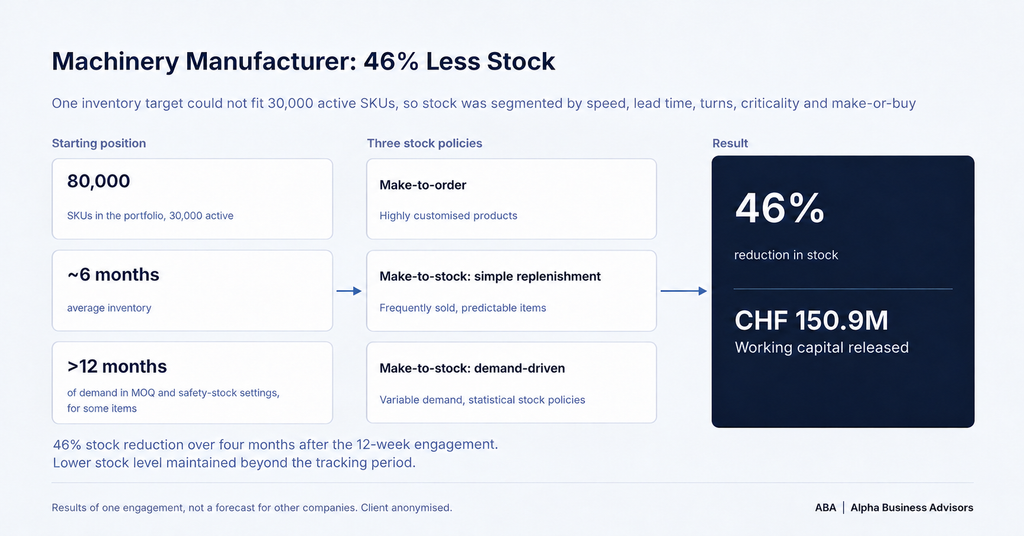
Its catalogue comprised 80,000 SKUs, approximately 30,000 of them active, with inventory equivalent to roughly six months. Some SAP minimum-order and safety-stock settings exceeded twelve months of demand. Certain products were also being held against infrequent, unusually large customer purchases.
Despite these differences, the business used a common approach to forecasting demand and calculating stock requirements.
We grouped products according to their movement, replenishment lead time, stock turnover, component criticality and whether they were manufactured internally or purchased. Customised products were distinguished from predictable items suitable for straightforward replenishment and products whose variable demand required different stocking policies.
The 12-week assignment combined diagnosis with changes to SAP’s purchasing parameters. These changes reduced the quantities ordered and the amount purchased, preparing the business to run down its excess inventory.
After the four-month observation period, inventory decreased by 46%. Products representing CHF 150.9 million in inventory value were sold without equivalent replacement purchases, allowing the cash to be deployed elsewhere.
Purchasing continued at smaller quantities, preventing the cleared inventory from being rebuilt to its previous level.
The purchasing settings gave practical effect to the stock policies. Without that connection, the clearance activity would have left the previous replenishment logic untouched.
Following the Decision Through to the Next Order
A safety-stock setting can be changed quickly. Establishing whether it should be changed takes judgement.
The quantity may reflect a customer’s ordering behaviour, a purchasing condition or a genuine service requirement. Depending on the cause, a workable reduction may involve a commercial agreement, revised purchasing rules or a targeted system change.
The CFO therefore needs visibility beyond the proposed inventory balance. Approval should extend to the operating decisions supporting it, including the cost and service consequences the business is prepared to accept.
Those decisions must be reflected in the instructions followed by purchasing teams and in the calculations used by their systems. Otherwise, an approved reduction can be undone through entirely routine orders.
ABA’s Rapid Inventory Reduction Work Package examines inventory against demand, defines appropriate product segments and stock targets, and identifies recommended system corrections.
If working capital is trapped in inventory, speak with us about where a reduction is justified and which purchasing changes would help maintain it.









0 Comments